Category: Calculator

Student-Friendly Calculus Tools – Step-by-Step Math Problem Solvers

Trust in GoCalcability for My Students

While my students also do much for GoCalc, tools that can be trusted when one needs to go from understanding to real particnzd problem solving. And despite the fact that financial resources largely hinder people of certain classes-type only whit is done that is worthwhile-pure learning. If topics are useful outside school, this coenzyme detergent can provide electronic calculators for free. And using GoCalc will let the poorer at least get something to support social media education, be they equal to a sum of privileges, once I do use them in own class.

Certainly-Applications Worth A Second Shot

    To set the record straight, in the world of education, time is given an entirely different meaning. Teaching is a spurt of activities and engagements: lectures, office hours, grading assignments, curriculum preparation, et cetera, implying a need amongst these tools to be in instant alacrity when called into action. With GoCalc, these tools have proven to be great, by being technologically savvy across all platforms and browser-based, so no extra downloads are needed for the students, lessening compatibility phases from the shadows of significant goods placed in one’s lap. Laptops of inertia on a table in the library could be used, along with a tablet I fired up in the retreat hall, and, for others, their mobile amid the corporate building. Immediate access to all needed gadgets allows them to save their full posts until cleaning it up so as not to let go of any more time thereafter.

    • An anti-derivative calculator is the best way for a student to learn the integration process.
    • For a college multivariable calculus student, the triple integral calculator is an invaluable asset for exhibiting many of the main features of multidimensional integration.
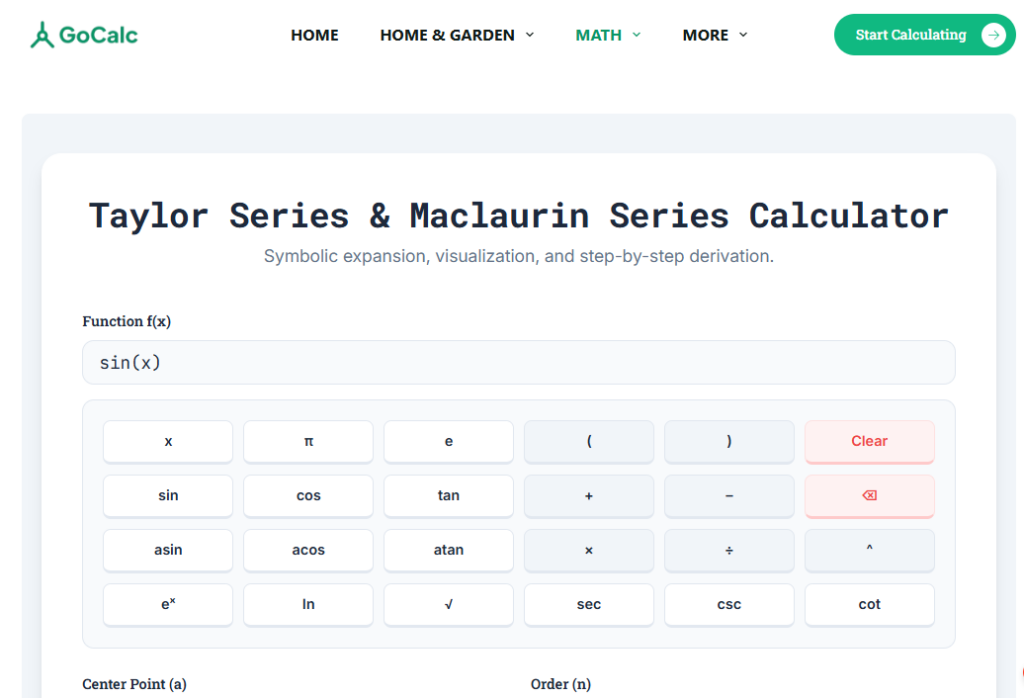
    • For a high school student, the Taylor Series Calculator is very helpful to decide the actual degree of polynomial approximation and to consider convergence.
    • Power is calculated by integrating rational controls and yielding indexes.
    • The Radius & Interval of Convergence Calculator will make the hardest aspect of the calculus series more straightforward.
    • The Second Derivative Calculator is an important resource in the study of concavity, inflection points, and optimization.
    • The Riemann Sum Calculator is an introduction to numerical integration.
    • This critical point calculator makes it a cakewalk for college students to find the local extrema and give a sense of interpreting the function.
    • The concavity calculator is very helpful in learning curve-sketching and graphical analysis.

    In Changing Times

      A good by-product of using GoCalc to build student confidence that I have observed is the ability to significantly diminish that somewhat fixed (albeit quite natural) resulting eagerness to question oneself whenever the student does the calculus. My students, therefore, are able to use a calculator referred to earlier on to check right answers; thus, they can have two advantages: If the answer is right that essentially gives them even more. Just as important, inaccurate answers help one realize that they are incorrect in their thinking patterns. The students can use the prompt to help unlearn that pattern best out from here.

      Learning Support at Gentle Steps

      Teaching with GoCalc was greatly reinventing the painful experience of my class. A considerable amount of my time was spent on identifying computational errors that had jeopardized students’ conceptual understanding. Now that a gradual change has occurred, students are able to check all of their computations out of class. Therefore, more in-class time is available for presenting conceptual ideas, elaborating on applications, and nurturing mathematical intuition. The revamped mode has improved class participation by great leaps and bounds and, with time on my charity, I was able to take up more advanced topics instead of looking back to fix small arithmetic problems.

      Thus, rather than spending time with them on computational work, we could be investigating and discussing the deeper underlying mathematical ideas before me suggesting the use of GoCalc. Through GoCalc, students could comprehend and cross their computational working out while on their own time, allowing the majority of our classroom time to be devoted to “really important” things-kicking around these cool ideas, applying mathematics in different contexts, and their favorite-developing mathematical intuition. A shift like that has led to better participation in class discussions and has allowed for more advanced courses to find their place, because it turns out that we are not wasting loads of valuable classroom time on arithmetical mistakes.

      Supporting Different Learning Styles

      Different students have refined ways of learning and the calculator range for GoCalc aids such differences. Some people might be very good with derivatives, but the very thought of integration will just stop them on their tracks. Some might be superb at series convergence but find other areas like Limits to be a totally different hell. Mayo, through our unique topic calculus calculator standards, gives students prop support right there where they need it. Some students just appreciate Riemann sums visually while treating limit calculations like their better half. This is how every other detail is adjusted to the varieties of learning style.

      Preparing them for real-world problems.

        At the end of the day, I am an educator whose responsibilities are not solely exam-oriented but career-oriented in the burgeoning disciplines of science, engineering, economics, and technology where calculus might be deemed the tool of daily use. In the profession, expert people always know and utilize the software tools such as Mathcad or Maple to verify the calculations done out with integration. By teaching them some ways to get the idea of GoCalc into their own hands within a sense of that very basic capability that’s learned between each step on the path, I am not just teaching calculus at all in any way. I am teaching problem-solving that is practical and looking like service in the narrow corridor of their career.

        Financial repercussions

        In my own experience as a teacher, I have found that simplifying calculus to the best of one’s efforts for students has always been the most honorable aim. With even most simple words, and even fun! The balance of proper perspective and engaging presentation is to help students view the tableau of this display altogether. I have found this probability calculator the closest friend I could have: carried by plethora of study resources on calculus, it works pro bono, offers prompt services, and possesses an array of other features highly desirable for teaching students academically. For the utmost effective teachers, who are searching for some good stuff to suggest or adrift in the waters of calculus, GoCalc will serve an apex onto which they must lay their eyes. The convenience and quality of these problem solvers in calculus have effectively revolutionized my teaching setup, and my observations are that they must play a significant role toward enhancing your learning process.

        I assure you the use of tools is never a substitute for features; on the contrary, tools enhance the spirit, energy, and triumph of your undertaking. Therefore, thus has GoCalc become eternally enshrined in my pantheon of resources for teaching, and I should, with reverence, continue to recommend this app to anyone stepping into my classroom and asking to learn the intriguing calculus.
        Free Calculus Calculators for Students – Solve Derivatives, Integrals & Limits

        When GoCalc‘s massive calculus calculator pack was first presented to me, I was rather skeptical that such free online resources could carry accuracy and reliability for my students. After a rigorous semester’s worth of testing, I can now only lean even more on GoCalc as if enjoying it as an education tool. This setup includes many different calculators for derivatives, integrals, limits, and much more-all for free, which I may successfully employ professionally.

        The Time-Saving Benefits That Change Homework Sessions

          I have discovered that the important gain was that students utilized to pore over their work manually which is consummately diminished by GoCalc. In the past, my students would often toil to the point of giving up because of manual recounting that left them uncertain with the state of irritability due to the matching of errors. Now, with the GoCalc calculator for antiderivatives, calculator for limits, calculator for second derivative, etc., they can match their answers within a wink; this kind of fast feedback shifts their focus from hunting down errors to understanding the concepts. I have very dearly monitored how homework submissions rose at one time by approximately 40%, a good sign of a successful application of these tools in class.

          Instant Verification for Greater Confidence

            Math anxiety is a real phenomenon. For most kids, calculus is the peak of their anxiety in this respect. The aspect that I find most appealing about GoCalc is that it transforms the whole experience from the fear of math to a confidence-building process for the student. As some students assiduously check their problems using a Taylor series calculator or Riemann sum calculator, positive feedback from the help builds up their belief in mathematical ability. I have personally observed previously quiet students regress into intense discussions at the sight of some effective means to check their problem-solving method with fairness-without being made aware of their answers.

            Overall development of fundamental calculus concepts

            The GoCalc platform besides the basic derivative and integral calculators offers nearly all the complex topic-wise calculators that find utility in all the subjects that I teach: for optimization queries, the critical points calculator; for curve analysis, the concavity calculator; let’s say GoCalc has all the aforementioned things. In my Advanced Placement classes, the power series calculator and RoC (radius and interval of convergence) calculator are sure-time crowd-pullers. Owning around 39 different calculus-related calculators means that students always have the right tool for a particular question.

            Perceptual Learning Style and Deep Understanding

            One of the very difficult questions for me as a teacher has been to impart increasingly abstract calculus concepts in an easier way to visual learners. This is where GoCalc comes in. GoCalc calculators are the only ones that offer numerical solutions with a complete breakdown of each step accompanied by graphical representations of the underlying mathematics, giving the student the chance to actually see how their solutions correspond to geometric interpretation. This visual display helps to tie procedural knowledge to conceptual understanding, which is vital for long-term retention and use of calculus principles.

            Accessibility Is For Everyone And Nobody Is Left Behind

              This is why I promote educational equality when I teach. Already, not every student in a class of mine can pay for a graphing calc or software subscription. GoCalc allows such underprivileged kids to access top-tier tools for free, removing all barriers that hinder their learning. Basically, here is how it works: students who can use the Internet (whether that be a phone, tablet, or computer) can have equal access to the topmost quality in calculators. Such welfares make sure no student is held back by a lack of funds throughout their catching up in calculus and they definitely discover success.

              Real-world Problem Solving You’re Preparing Students For

                Computational tools are really important for situations wherein data is the main foundation; thus, being skilled in posing computing problems is as important as mastering calculations by hand. Through GoCalc, it is crucial for me to teach the students some modern trick to ease comprehension of the highly complex process of problem-solving via technology. Basically, engineers, data scientists, economists, and scholars all depend on computational tools to solve their automation-driven work. I believe that GoCalc-like platforms provide not only a stepping-stone to the nitty-gritty stuff of STEM careers for my pupils but also contribute vastly to a comprehensive calculus education for them that endures heavy examination.

                GoCalc in the Classroom: Endorsing My Teaching Philosophy

                  Adding GoCalc to my teaching strategies was like a duck to water, especially because it did not undercut mathematical rigor in any way. Required are that students show their work and that they demonstrate being well-versed in the principles behind the mathematics. Yet there is this supportive, catering side that GoCalc offers, for validation and for reinforcement. The no-hand-held-calculator policy during algebra examinations encourages students to be more skillful in finding solutions, but on the other hand, it sometimes supports them in determining an corrected answer as they go through their learning process during homework, projects, and other creative activities. This helps them to ground knowledge in theory against practical exposure.

                  Catering to Diverse Learning Styles and Pace

                    For a classroom, the necessity of differentiated instruction complements the multitasking differing paces and learning styles among students. While a pupil may say, “Now that I have connected the dots today with long division, my buddy just stands there and scratches his head!” differentiated teaching is all about maximum variation, doing numerous tools available to help students who are not likely to learn in the same way or in a single way. For instance, multiple online calculators proposed by GoCalc will take students on their voyage through a wilderness of increasingly complex problems such as triple integration or Taylor series calculations, even outside the curriculum and syllabus. So to talk about students who are finding learning sheer despair, more practice opportunities only expand with these calculators like triple integration or Taylor series calculus; and for consolation, confidence only immerses in the shyness of trying more problems. This comes in especially handy right here for the students to ascertain if they are working correctly at each step. This flexible system permits me to mesh my teaching to the student’s pace and match the breadth of each student’s individual learning needs.

                    Resources For Lifelong Learning and Beyond

                      What most impresses me about GoCalc is that its value knows no bounds of the classroom alone. I have had some ex-students telling me that they still go on using these calculators even when going by their college courses and their careers. So far, my platform has served as a lifelong learning resource accompanying students in their ascent through higher engineering and scientific research programs. I am relaxed in my endorsement because now I am introducing my students to a tool they can find useful for many years.

                      Personal Note: A True Recommendation From A Teacher

                      I am extremely glad to see how student commitment, connection with the material, and self-confidence in a Calculus classroom get an instant boost once they are exposed to GoCalc in a dull and drab stock set of instructional materials. Between the breadth of coverage, accuracy, and an overall ease of use in online access, that’s the other quality that allows them to feel urgent to become a study aid friend for any calculus student needing any help with that. High school students may require some computational reinforcement to grasp the newest derivatives concept or power series convergence: GoCalc is just the software that they could avail.

                      May I say without any excuses that every math teacher must tap into Go Calc for miles of exploration! Introduce these calculators to these fresh minds to revolutionize their entire perspective of calculus. Technology advancements, if married with the traditional style of education, would shape math education in the coming years-that’s what Help Calc accomplishes! In calculus, make Go Calc one of the factors that will let your students gain insight by giving them more in higher learning.

                      css.php